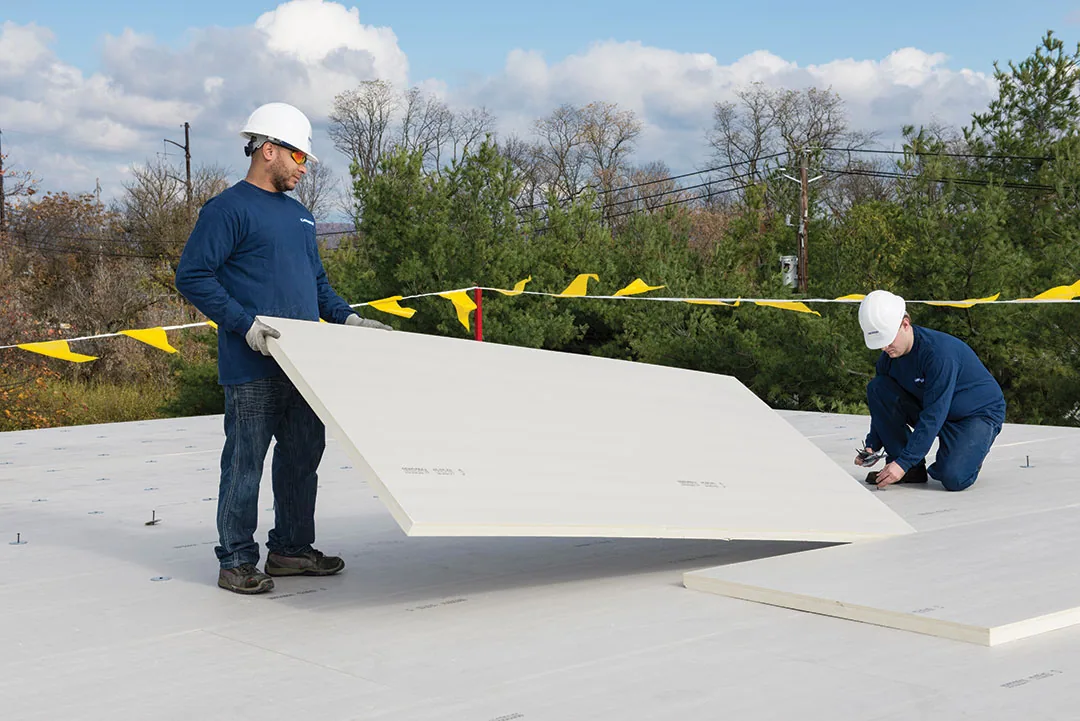

Fitness Center Roofing in Brooklyn, NY
A wet spot on a rubber gym floor is rarely the roof's first sign. More often the first sign is a dark ring on a tile over the free weights, or a bucket parked behind the studio door. A fitness building stacks a lot of risk under one lid: high ceilings, long spans, big rooftop units that pull hard on the roof, and a humid air load that attacks the underside of the deck. When a leak starts, members notice the drip and the smell long before the owner has been on the roof.
A scope comes after the walk: the field, the curbs, the soft spots and a photograph of each flashing.
What a fitness roof carries
Gyms and rec centers sit in a range of buildings. Some operators take converted industrial space of the kind found in parts of Sunset Park, where Bush Terminal was built in stages from 1911 to 1926. Some sit in purpose-built blocks with a flat roof and a short parapet. Some are rec centers beside a school or a college campus.
The first step is to map the roof, scan it for moisture and cut a few cores. What a fitness roof tends to carry is rooftop air handling, exhaust for locker rooms, makeup air for studios and sometimes pool-hall dehumidification, and every one of those is a curb that has to be flashed and kept tight.
Load is the other thing to count. Rooftop units for a gym run long hours, and their weight sits on a few curbs. If a curb was set on a deck that has since rusted or sagged, the unit leans and the flashing splits. The deck around every heavy curb gets probed and any movement noted.
Where it fails
Curbs. Heavy rooftop units rest on curbs, and the sealant around the cap and the base flashing tire from vibration. Drains. Water on a flat roof heads for a few outlets, and a basket choked with grit leaves it standing. Seams. A membrane that has been through many hot Julys opens at the laps. Underside. Moist air from showers and pools rises into the deck and condenses, and a vapor path through the roof can wet the insulation from below.
That last one fools people. The roof can look sound from above and still hold wet insulation that came from inside the building. A moisture scan and a few core cuts separate that from a leak at a seam. If the insulation is wet from below, patching the surface does not fix it; the air path does. Insulation and cover board layers decide how well a roof resists both heat and moisture.
Edges and parapets complete the list. A cracked coping joint feeds water into the wall behind a locker room, where it can sit for a long time before a stain appears. We read the coping joints and the counterflashing on every wall that borders conditioned space.
Humidity and the deck
A pool hall or a hot-yoga studio puts a lot of water vapor into the air. In winter, when the roof deck is cold, that vapor condenses where it meets cold metal or a cold surface. Steel decks rust, insulation soaks, and drips fall that look like leaks. A good roof assembly for a humid space has a vapor path designed for it, and a ventilation system that keeps the air moving.
When we see rust blooms on the underside of a deck, we test the insulation above and mark the area. The repair may involve the mechanical system as much as the roof. We tell the owner which part belongs to which trade, so repair money is not spent twice.
Ventilation upgrades often happen at the same time as roof work, and the two should be planned together. A new exhaust fan needs a curb that is flashed right, and a rebuilt curb should be sized for the equipment that will sit on it, not the one that was there.
Storms, snow and heat
Snow of roughly 30 inches a year loads a flat roof, and 27.3 inches came down on January 23, 2016. Meltwater runs toward the drains, and ice in a drain bowl dams it. A roof outlet that handles ordinary rain can overflow in a cloudburst like the one that came with Ida's remnants on September 1, 2021. July highs near 85 F and the city's heat island leave a fitness floor warm before the first class starts. A fitness building already fights heat inside, and a dark roof adds to the load. A reflective surface cuts the cooling work when the roof beneath is dry and sound. Facilities near the water take the wind that comes with a coastal storm.
We mark blistering, open laps and softened sealant on the plan after each hot summer, so the next visit starts from a record and not from memory.
The fix in order
Dry in active leaks. Scan and core. Sort the roof into repair, recover and replacement. Fix the curbs and drains first, since they are the cheapest and most common leaks. A dry roof with a worn surface may take a coating or a recover. Wet insulation comes out.
A gym cannot close for weeks, so the schedule matters. Noisy tear-off runs in the early morning or on quiet days, equipment shutdowns are coordinated with the operator, and interior protection goes up under the active area. An occupied building reroofing plan sets out each zone, the hours and the cleanup routine.
Price follows access, the number of curbs and the length of equipment shutdowns. Winter work is mostly repair and dry-in, since membranes want dry surfaces and moderate temperatures. Roof drains are cleared before the first freeze, because ice in a drain bowl can crack the clamping ring. Members notice a closed studio faster than they notice a patched roof, so each stage is planned to keep the busiest rooms open for as many days as the weather allows.
Closeout walk
At the final walk the operator sees each curb, flashing and drain photographed, and the manager takes away a roof plan numbering every penetration. A fitness operator with more than one location, or a nearby rec center run by a school or college, can rate every roof on the same scale. Gyms on school and college campuses raise the same concerns. Facilities near Sunset Park, Flatbush or Sheepshead Bay follow the same steps.
Commercial Roofing Questions
How can I tell whether a ceiling drip comes from the roof or from condensation?
Match the drip to the weather. A roof leak follows rain and snowmelt. Condensation follows cold, dry mornings and busy hours with heavy humidity. A roof moisture scan plus a look at the deck underside tells the two apart.
Can a gym stay open during a reroof?
Usually yes. We work in zones, protect the interior under the active area and schedule noisy stages early or on quiet days. Equipment shutdowns are agreed with the operator in writing.
Does a fitness building need a different membrane?
Not always. The membrane choice follows the roof, the deck and the budget. The vapor path and the ventilation matter more in a humid space, and we plan them before the membrane is ordered.
What should an operator send before a field walk?
To book the walk, an operator supplies the address area, the roof age, pictures of the worst drain and the ceiling stain, and the position of the heavy rooftop units.